
Learn how to get into Google AI overviews with proven SEO tactics. Master ai overview ranking tips, SGE SEO & optimize content for AI results.
Introduction
If you’re an SEO in India reading this, you’ve likely noticed something shifting on Google Search. Increasingly, queries now begin with an AI-generated summary or “overview” above the organic listings. These Google AI Overviews are part of Google’s push into Search Generative Experience (SGE), and they’re changing the rules of ranking forever.
So, how do you get into Google AI overviews? What is the secret strategy that top SEOs aren’t talking about (or are just starting to figure out)? In this blog, I’ll walk you through a step-by-step, data-driven, actionable framework tailored for Indian audiences and SEO realities to boost your chances of appearing within these coveted AI Overviews. We’ll also discuss AI overview ranking tips, how to rank in AI search, Google Search generative experience SEO, SEO for Google AI overview, and optimizing content for AI results in depth.
Let’s dive in.
What Are Google AI Overviews & Why They Matter
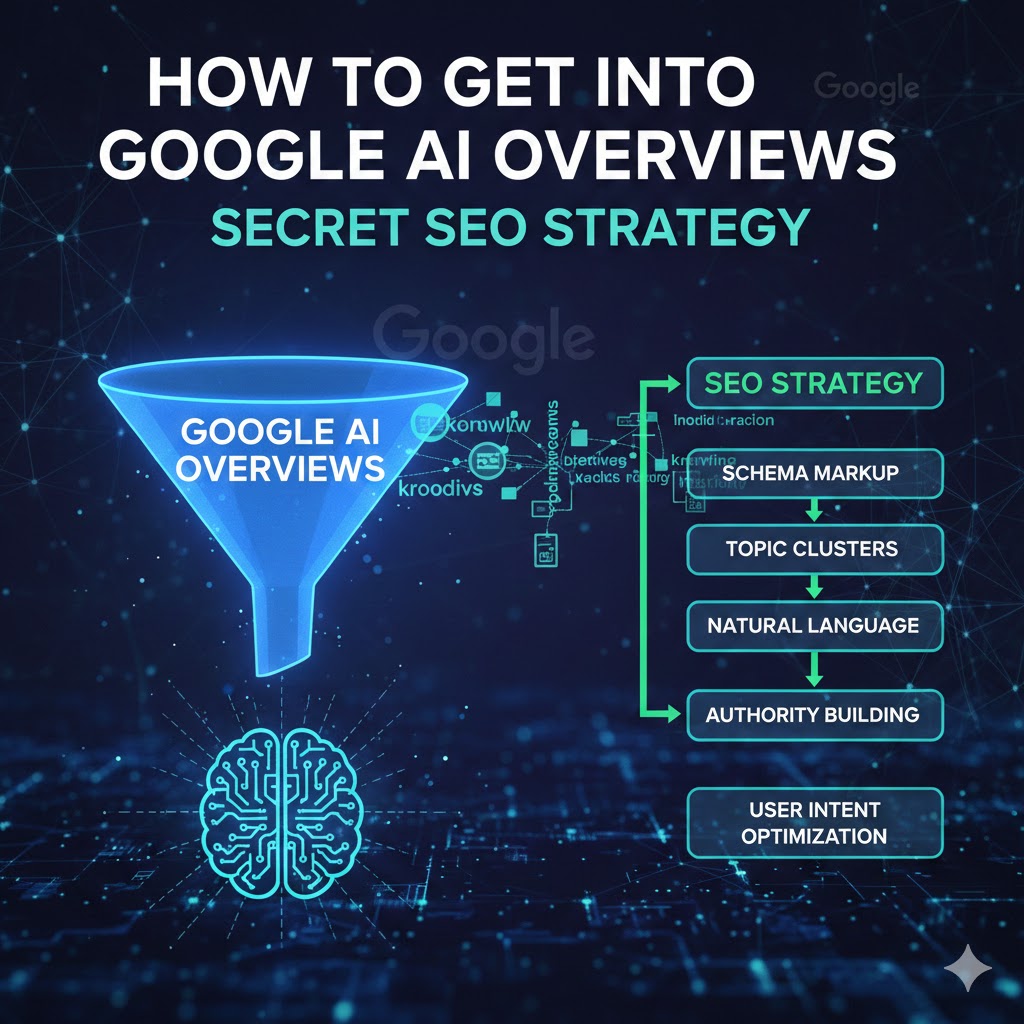
“Visual representation of how Google AI Overview collects and summarizes information from multiple websites into one concise result.”
Understanding AI Overviews and SGE
Google’s AI Overviews (also known as generative summaries or snapshots) are AI-generated summaries of a query that appear above or near the top of the search results. They aggregate information from multiple sources to provide a distilled answer, while also linking to supporting pages for deeper reading.
These overviews are part of Google’s broader Search Generative Experience (SGE). Under SGE, Google is blending traditional search with generative AI models (such as Gemini) to provide direct answers, context, reasoning, and multi-step exploration.
In India, Google is actively localising SGE featuresallowing toggles between English and Hindi, voice input, and language switching in responses.
Why SEOs Should Pay Attention
→ Screen real estate is shrinking: AI Overviews often push traditional links further down, reducing click potential.
→ CTR impact: Research shows average CTRs decline ~15% for keywords triggering AI Overviews, especially for non-branded terms.
→ Traffic redistribution: When AI Overviews appear, Google tends to surface links from more diverse websites, offering new opportunities for less obvious domains.
→ Future is generative: AI Overviews are still evolving. Brands and content creators who crack the formula now will enjoy first-mover advantage.
Because of these shifts, the question isn’t just “How to rank on page one?” but now “How to rank inside the AI Overview?” or at least be cited by it.
The Secret Strategy SEOs Aren’t Talking About
Ranking for AI Overviews isn’t just about optimizing like you did for featured snippets. It’s about influencing the generative model’s source selection, aligning with Google’s AI reasoning, and building content that is semantically rich and trustworthy.
Here’s a deeper strategy:
→ Build influence signals, not just ranking signals
The AI engine behind Overviews doesn’t pick just from the #1 organic result. It considers multiple documents, reasoning chains, and nuance. To influence inclusion:
- Write pillar content that becomes a core authority in your niche.
- Create supporting sub-articles that link to the pillar and cover subtopics deeply.
- Use internal linking strategies that mirror how the AI might reason (e.g. parent → child → sibling content).
- Gain authoritative backlinks to both the pillar and subtopicsto signal your domain is trusted across multiple angles.
In short, you’re not just chasing one page’s ranking; you are architecting a content ecosystem that becomes hard for the AI engine to ignore.
→ Optimize for query reinterpretation & expansion
AI Overviews often perform “query fan-out”breaking your query into sub-questions, rewrites, or variants.
So your content should anticipate variations:
- Use synonyms, related phrases, and query variants inside the content.
- Use multiple question formulations (“what is X,” “how does X work,” “why X matters,” “X vs Y”).
- Include subheaders or sections that directly address these variants.
This way, your page becomes relevant across the fan-out queries the AI might explore.
→ Use structured reasoning cues & micro-signals
Less talked about but powerful: embedding signals that help the AI reason that your content is a solid choice.
- Use structured formats (lists, tables, comparison matrices, pros/cons) to make your content “reasoning-friendly.”
- Use data, examples, and stats to show factual grounding.
- Use semantic markup, schema where possible (though AI Overviews doesn’t require special schema) to reinforce context.
- Break complex explanations into stepwise chains, which mimic how generative models build reasoning.
When you mirror how the AI “thinks,” you increase the odds it’s going to pull from your content.
→ Leverage freshness, updates & reputation
Overviews favor content that’s up-to-date, trustworthy, and from credible sources:
- Regularly refresh and expand your content, slipping in the latest data and examples (for the Indian market: Govt schemes, case studies, trending local brands).
- Show author credentials, brand trust, and citations.
- Get your content cited or referenced by authoritative sites, Indian publications, niche community sites, govt or academic domains.
In many ways, you’re signal-stacking: domain reputation + freshness + structural clarity + reasoning cues.
Step-by-Step Framework: How to Get Into Google AI Overviews
Here’s a tactical flow you can follow:
→ Step 1: Identify AI-prone queries (keyword research)
Not all keywords trigger AI Overviews. Focus on:
- Informational, complex, multi-step queries
- Queries with “how / why / what / compare / best”
- Long-tail conversational queries (e.g., “how to get into Google AI overviews”)
- Use tools like Google Search and Search Console to see which queries already trigger AI Overviews in your niche
Filter your topic list to those that:
- Already show AI Overviews (you can test manually).
- Are semantically broad and have multiple subtopics to fan out.
→ Step 2: Create your content ecosystem
- Create a pillar article as the central deep guide for the main query.
- Build cluster articles covering subtopics, expansions, cases, myths, and stepwise guides.
- Use topic clustering & strong internal linking (hub-and-spoke model) to tie them logically.
For the Indian context, you can leverage local brand examples, e.g., “How Flipkart used AI in search” or “AI Overviews in Hindi queries,” to show depth.
→ Step 3: Craft content with AI reasoning in mind
- Use question-style subheadings: “Why does X matter?” “How to do X step by step?”
- Use structured data-like tables, numbered steps (though avoid literal numbering in blog you can say “Stepwise” but in text).
- Incorporate multiple facets/viewpoints: pros & cons, trade-offs, limitations.
- Embed quotes, data, and references (especially from credible Indian sources).
- Use images, charts, and diagrams to support reasoning.
→ Step 4: Signal authority & trust
- Use author bios, credentials prominently.
- Add references and citations (especially Indian brand data, govt sites).
- Seek backlinks from respected sites in your domain (Indian blogs, news portals).
- If possible, publish case studies showing your own metrics or client data.
- Use update logs or revision dates to show freshness.
→ Step 5: Monitor & iterate
- Use Search Console to see which queries trigger AI Overviews and which pages are being clicked.
- Use Analytics to measure dwell time, bounce rate, and engagement.
- Identify cluster pages that perform well and expand or merge low-performance pages.
- A/B test different formatting, reasoning cues, and title tweaks to see what correlates with inclusion in AI Overviews.
You often need to iterate 2–3 cycles before the AI model “notices” your influence signals.

“Infographic showing hybrid citation anchoring — pillar page and micro-topic pages connected to Google AI Overview through citation links.”
Deep Dive: Google Search Generative Experience SEO
SGE demands a new mindset beyond traditional SEO. Here’s how to align:
Semantic & conversational optimization
SGE is tuned for natural language. So your content should:
- Use conversational tone (what you’d say to a human asking).
- Handle contextual follow-ups (anticipate questions that stem from the main query).
- Use entity-based writing (mention related people, tools, domain jargon)
- Use latent semantic indexing (LSI) terms & topical depth not just the target keyword.
Multi-step / reasoning answers
SGE often breaks your question into sub-questions, reassembles, and provides reasoning. So:
- Design content that provides multi-level explanations.
- Use “If X, then Y; but if A, then B” style explanations.
- Use decision trees, comparison tables, and scenarios.
This helps the AI build a chain of reasoning using your content.
Authority & trust reinforced
Because AI can hallucinate or pick weak sources, it leans on more trustworthy domains:
- Use E-E-A-T (Experience, Expertise, Authority, Trust) principles heavily.
- Show real author experience, case studies, and credentials.
- For local relevance (India), cite Indian data, Indian institutions, and credible Indian websites.
- Use clear disclosures (if it’s your brand’s content) to build transparency.
Focus on coverage, not thin content
SGE penalizes shallow content. So:
- Go deep, comprehensively cover subtopics, exceptions, and user intent.
- Use “What if” or “Edge case” sections to show you’re thorough.
- Continuously refresh content with new trends, references, and changes.
Content influence metrics
SGE’s generative engine is evolving; recent research (such as the 2025 GSEO framework) suggests influence is measured by semantic weight, reasoning contribution, and content centralitynot just keyword density.
This is why your content ecosystem and reasoning cues matter more than just “on-page SEO.”
SEO for Google AI Overview: Additional Tips & Tactics
Here are more tactical tips that often go unmentioned:
→ Use “supporting snippet candidates”
Inside your content, include mini-summaries or well-written sentences that can independently serve as summarization candidates. These are beacon lines the AI might pick to build the overview.
→ Strategic use of anchor text
Your internal links’ anchor text should mirror how AI might reference subtopics (i.e. conversational form, not just keywords). For example: “learn how AI Overviews work” vs “ai overview features”.
→ Co-author or guest contributions
When a credible domain co-authors or references your content, it gives additional authority that the AI engine may weigh when selecting sources.
→ Use “update triggers”
Set periodic refresh triggers (quarterly) to add new data, trends, and Indian-specific examples. This signals freshness, which AI models prefer.
→ Localize where relevant
For India, localize language (Hindi toggles), mention Indian brands, and use local stats (e.g., growth of AI usage in India, Indian search behavior). This helps Google see your content as regionally relevant (especially in Indian searches with AI Overviews).
→ Monitor overlap with Featured Snippets
If a query triggers both a Featured Snippet and an AI Overview, they often compete. You’ll want to optimize for both so your content can be picked in either format.
Case Study / Hypothetical Example (India context)
Let me illustrate via a hypothetical (based on observed patterns):
Suppose you run a tech blog in India, and you want to rank for “how to get into Google AI overviews” (our target). You follow the steps:
- Create a pillar guide: “Complete Guide: How to Get Into Google AI Overviews” (this very blog).
- Make cluster posts:
• “AI overview ranking tips for Indian SEO”
• “How to rank in AI search in India”
• “Optimize content for AI results – India case”
• “Google search generative experience SEO explained” - In each cluster article, you internal-link richly:
• The “ranking tips” post links back to the pillar with anchor text like “how to get into Google AI overviews.”
• The pillar references stats from Indian tools (e.g., Search Console, Indian SEO firms), local brands like Flipkart, Swiggy, or news portals that discuss AI or Google. - You include structured tables, stepwise chains, and comparative sections (“Before vs After AI Overviews”, “Limitations/edge scenarios”).
- You show your author credentials (say, “X years in Indian SEO, worked for Indian startups”).
- You refresh this content periodically (e.g., after new Google updates).
- Over time, you begin to see in Search Console that queries triggering AI Overviews now surface your pillar + cluster pages. You also notice improved dwell time and engagement, which you continue optimizing.
With consistent iteration, your content becomes part of the “reasoning fabric” that AI Overviews draws upon.
Future Trends & What to Watch
- Generative models will become better at multi-modal summarization (mixing images, tables, video) so embedding infographics or short videos might help.
- AI engines may start attributing source weight scores based on domain “influence contribution”making your content ecosystem even more critical.
- Voice & conversational queries will grow (especially in India). So having a “spoken answer version” or a simple language summary may gain an advantage.
- AI Overviews may incorporate user preference tuning (e.g. “simplify this answer,” “go deeper”), which may favor content structured for multiple depth levels.
- New frameworks like Generative Search Engine Optimization (GSEO) are emerging to formalize strategies beyond classical SEO, focusing on content influence.
Stay adaptive and keep testing.
Conclusion
To summarize:
- Google AI Overviews are rapidly reshaping SERP dynamics.
- Traditional SEO alone isn’t enough to influence generative models.
- The secret strategy is to build an authority ecosystem, optimize for query reinterpretation, embed reasoning cues, and signal trust and freshness.
- Use a content hub model, monitor performance, and iterate.
- Localize for the Indian audience with regional examples and language relevance.
Next Steps for You:
→ Audit your top informational pages.
→ Identify queries in your niche that already trigger AI Overviews.
→ Build or expand your pillar + cluster content.
→ Update your content with reasoning cues, Indian examples, and data.
→ Monitor via Search Console & Analytics.
→ Iterate 2–3 cycles and test formatting tweaks.
By following this framework, you tilt the odds in your favor to get into Google AI Overviews rather than being left behind.
Monitor, Analyze, and Improve – Use Google Analytics, Search Console, and other SEO tools to track progress and tweak strategies for maximum growth.
FAQs
Q: What exactly qualifies a query to trigger a Google AI Overview?
A: Queries that are informational, complex, or multi-step often trigger AI Overviews. Google decides when a generative summary adds value beyond traditional Search.
Q: Do I need special schema markup to rank in AI Overviews?
A: No. AI Overviews don’t require a special schema. Instead, core SEO fundamentals (indexability, content quality, E-E-A-T, internal linking) still apply.
Q: Can a low-authority domain get into AI Overviews?
A: It’s harder, but possible via niche expertise, strong internal linking, freshness, and content ecosystem architecture. The more signals you stack, the better your chance.
Q: Does having a Featured Snippet help or hurt AI Overview chances?
A: It can be a double-edged sword. If both appear, they may compete for space, reducing CTR. But good snippet optimization is still relevant.
Q: How long does it take to influence generative models to pick your content?
A: It depends on your domain strength. Generally, 2–3 refresh cycles (3–6 months) may be needed. Consistency and iteration are key.
Q: Can I block AI Overviews from showing my page?
A: Yes, via nosnippet, max-snippet, or data-nosnippet directives. But doing so sacrifices visibilityespecially because AI Overviews often bring traffic.
Q: Will AI Overviews make SEO obsolete?
A: No. They change the game but don’t eliminate it. SEO must evolve into influence-driven, reasoning-aware strategies. Traditional ranking still matters, especially for long-tail and brand queries.